In this episode of Creative Guts, co-hosts Laura Harper Lake and Becky Barsi chat with April Landry, a comic artist, writer, and the organizer of the Luna Moth Zine Festival.
In this episode of Creative Guts, co-hosts Laura Harper Lake and Becky Barsi chat with April Landry, a comic artist, writer, and the organizer of the Luna Moth Zine Festival.
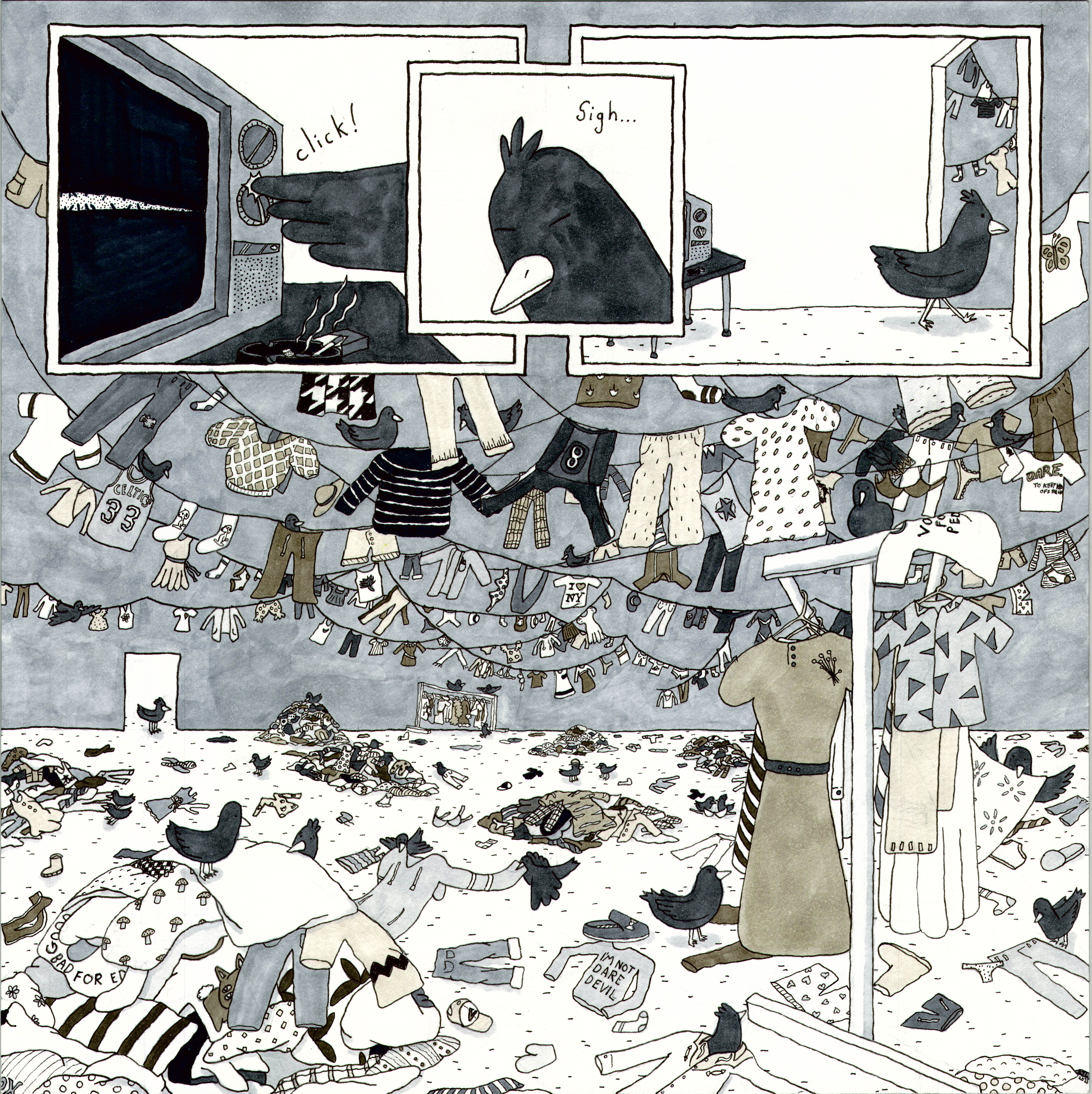
April uses digital and traditional art to help explain and deal with the world around her. In our conversation, we discuss using art to process emotions, zine making, the story behind the name of the Luna Moth Zine Festival, and much more. We also dive deep into one of April’s pieces entitled “Bird Laundry Thieves Cartoon ” that you must see for yourself!
Check out April's work at www.landrysesame.com and @landrysesame on Instagram, bluesky, tumblr, and ko-fi.
Learn more about the Luna Moth Zine Festival at www.lunamothzinefest.com and www.instagram.com/lunamothzinefest. The 2026 festival will be on April 18 in Manchester, NH.
Listen to this episode wherever you listen to podcasts or on our website www.CreativeGutsPodcast.com. Connect with us on Instagram, Facebook, LinkedIn, and Discord. Subscribe to our Substack newsletter at creativegutspod.substack.com.
If you love listening, consider making a donation to Creative Guts! Our budget is tiny, so donations of any size make a big difference. Learn more about us and make a tax-deductible donation at www.CreativeGutsPodcast.com.
Thank you to our friends at Art Up Front Street Studios and Gallery in Exeter, NH and the Rochester Museum of Fine Arts in Rochester, NH for their support of the show!
Any views or opinions expressed by our hosts or guests do not necessarily reflect the views or positions of Creative Guts.
[INTRODUCTION]
[0:00:00] LHL: I'm Laura Harper Lake.
[0:00:01] BB: I'm Becky Barsi.
[0:00:02] LHL & BB: And you're listening to Creative Guts.
[0:00:18] BB: Hey, there, everybody. And welcome to another episode of Creative Guts.
[0:00:22] LHL: On today's episode, we're talking with April Landry, a cartoonist and illustrator, who I had the pleasure of meeting, I think, for the first time, at the Luna Moth Zine Festival, which she is the coordinator of. She is into so much cool stuff and is a really amazing creative, so I'm really excited to talk to her.
[0:00:40] BB: Let's jump right into this episode with April Landry.
[INTERVIEW]
[0:00:47] LHL: April, welcome to Creative Guts.
[0:00:49] AL: Thank you for having me.
[0:00:50] LHL: This is very, very exciting. I think we officially met at the Luna Moth Zine Festival earlier this year, and you've been on my radar before that, but it is so exciting to talk to another creative who is also an organizer.
[0:01:04] AL: Yeah.
[0:01:04] LHL: Yeah. So, for folks who maybe aren't familiar with you, do you want to give us a quick dive into you as a creative?
[0:01:11] AL: Yeah. My name is April Landry. I would say I'm mostly a cartoonist at this point, but I used to be a musician. I've done some fabric work. I would just say I'm mostly a cartoonist. Yeah.
[0:01:24] LHL: Okay. And the driver behind the Luna Moth Zine Scene Festival.
[0:01:30] AL: Yes. Yeah.
[0:01:30] LHL: Yes? Awesome. Okay. Great. Cool. So, let's talk about you as a cartoonist first.
[0:01:35] AL: Okay.
[0:01:35] LHL: When did you start as a creative?
[0:01:38] AL: Ah, I'm going to be one of those people who says that they've been – I've been creative since I had a pencil in my hand or a crayon, basically. I was one of the people who was always in the back of the class doodling. And then I kind of got into music and didn't stop doodling, but didn't really focus on drawing for a big chunk of my life. And then when I got into a corporate job, I was always in the back of the meetings doodling.
And as music started to wind down for me, I was realizing that cartooning is something that I really wanted to do. I had gone to school to be a filmmaker. And I wanted to tell stories for a very long time. And I realized from film-making early on that you need 20 people and $20,000, or $20,000 worth of equipment. And even then, the idea you're going to have is going to go through so many changes and filters that you're just compromising and compromising and compromising.
I kind of stopped that, moved into the music stuff. And once the music stopped, I was like, "Oh, cartooning is a way to tell your stories and to do it in a way that you have full creative freedom." And I had read a couple books that kind of didn't change my life but opened my perspective on storytelling and comics and kind of got me to push into that space.
[0:02:46] BB: That's awesome. Quite a journey in terms of media. From going to something that does require a lot of other people to something that you can do in a solitary space as well, but also requires maybe insight into your own life, but also a community or the world around you. Telling those stories, that's wonderful.
[0:03:05] AL: Yeah. And I think more than anything, the through line is being a storyteller, wanting to tell stories about characters making tough choices and things like that. And also my own personal experiences going into comics as well.
[0:03:17] LHL: Yeah. On your website, you share using art to explain and deal with the world around you, which I love that phrasing. That is so much of being an artist, but that's a wonderful way to encapsulate it. Can you share more about that process?
[0:03:31] AL: Yeah. I mean, for me, art started as kind of like a mental health thing more than anything else, where I didn't think my art was good enough to share. I was mostly just making art to process my own emotions. I do a lot of stippling and really detailed stuff, where you can kind of turn your brain off just to focus on that stuff. And the brain never gets turned off. It just thinks about why did that person say that thing to me? Or whatever. Did I do that wrong over in another part of my life, or whatever it is. So it was a good way to just put on an album, think about something else, and focus on creating something.
And then on top of that, I was also going through a lot at different points, mostly around my gender stuff, transitioning. And there's always some new nugget to think about and to chew on around that kind of stuff. And often just saying stuff to myself, or thinking about stuff, or talking about stuff with other people, it got to a point where I could probably condense an idea or my thoughts or my experiences into a four-panel comic. Really crystallize it down into something. And it would take a lot of editing. But I'd be thinking about the idea behind a comic for weeks and weeks and weeks and talking about it with other people because I was processing it.
And then by the end of it, you almost have like a little piece of poetry that you can put illustrations to of just thoughts that you're dealing with. And that's kind of the other half of it, where it's like I use art to process the things going around me, and then I make art to process the things that are coming out of me, I guess, if that makes sense.
[0:04:54] BB: Yeah.
[0:04:55] LHL: You mentioned being a musician, and then you just mentioned poetry. Did you used to write lyrics?
[0:05:00] AL: Oh, yeah. Yeah. I was a bass player and a lead singer in a band. Yeah.
[0:05:03] BB: Wow.
[0:05:04] LHL: That's awesome. So, that kind of all weaves together. That makes total sense. Do you still play music?
[0:05:11] AL: Sadly, no. And it's one of those things where learning to draw is a full-time job for me kind of stuff, and always trying to improve is a full-time job. And I have a notebook of ideas that I want to get into comics, stories, things like that, that it basically takes up all of my artistic time. Where bass playing, I think you need an equal amount of time. But I get jealous of any artist who can somehow do both.
[0:05:33] LHL: Yes. Dan Blakeslee comes to mind.
[0:05:36] AL: Yeah. Yep. Yep. Yep.
[0:05:38] LHL: I feel exactly like that. I used to be in a band, and I sang, but I also played electric ukulele, which was really fun.
[0:05:45] BB: She also has an amazing collection of all sorts of instrument.
[0:05:48] LHL: Odd instruments. Yeah, very strange assortment of instruments. Again, I used to be in bands. I used to play out. And I definitely can't dedicate much time to anymore because I'm running an art business and trying to always get better at art.
[0:06:01] AL: It's really tough.
[0:06:02] BB: I love that you were talking about the doodling, though, and how you were the kid at the back of the class, but also you were in your corporate job in the back of the conference room. And how important it is for a lot of people, especially neurodivergent people, to be able to use doodling or just having some motion with the hand to be able to process.
I have ADHD. And so for me to not be multitasking or doing something that's activating the other side of my brain is really important. And so were you as a kid, and even in your corporate gig, drawing specific types of characters, or was it just kind of fun and random?
[0:06:36] AL: All over the place, depending on the day and depending on what I was going through. A lot of times it's abstract image stuff. I'll just start drawing circles and maybe connect shapes together and things like that. But then I always have like the go-to of just drawing cats is a big thing for me. But also, sometimes I'll have something that I'm working through, and I'll want to just practice. Maybe I was working on something about a frog. So I'd be just doodling frogs in the liners and stuff like that. But it really depends. Sometimes you draw a shape, and it looks like something, and you're like, "I'm going to turn it into that thing," and you just let it go.
[0:07:06] LHL: When you're at your corporate job drawing, are you like doodling on project summaries or like certain things? And then if that is so, do you take a picture of it or do you rip off pages and keep everything?
[0:07:20] AL: Oh, yeah. Yeah. I have a sketchbook at home, and if something I do at work ends up being really good, I'll just rip it off and tape it into the sketchbook kind of chronologically.
[0:07:29] LHL: I love that. I feel like I could just feel this tactile, this thick book of all these different –
[0:07:34] AL: Yeah.
[0:07:35] BB: Right. Right. A visual journal of how you documented the day, too.
[0:07:38] LHL: Yeah.
[0:07:39] AL: I'm not in offices as much anymore because of the remote work. I'm just fully moved over to like a generic, regular artist sketchbook.
[0:07:46] LHL: Yeah, that's awesome. Can we chat about your style for your comics and how it sort of evolved and where it came from?
[0:07:56] AL: Yeah. I mean, I didn't go to like art school for drawing or illustration work or anything. So, it's all self-taught kind of stuff. Obviously, I bought some books, did some practice, and went to classes. But nothing really legit kind of. So, it's mostly just doodling. Kind of just drawing lines. There's some anatomy in there, but it was just enough anatomy to just not look like I didn't know what I was talking about. And then I was like, "Okay, back to noodle arms and stuff like that."
Yeah. Honestly, I would say that when it comes to cartooning, it's mostly a mix of very cartoony people. So, it's very simple drawings. But at the same time, I want them to look like the people they are. There was a while where I was doing a project where I had to cartoon different bands, but you still had to be able to recognize the band without knowing who the band was. There's some trying to capture likeness in that. But at the same time, it's very cartoony, very fast. I try to be able to get a four-panel cartoon done in like a lunch break kind of thing is the goal.
But then on the other side of the spectrum is I love super detailed, super textured stuff. If there's an opportunity to do a lot of stippling or a lot of just super, super detailed, lots of things in an image together, I'm all for that as well.
[0:09:01] LHL: Yeah.
[0:09:03] BB: Yeah, you have quite a range. I'm looking at your work right now. And just in the comics gallery, even within that, there's so much variety in terms of material. It looks like you do hand drawing, but also digital work.
[0:09:14] AL: Yeah.
[0:09:16] BB: What is your process like? Do you start with that initial sketch just on a piece of paper and then digitize it, or do you work digitally and then maybe print out a version and paint on top? What is that process like for you?
[0:09:27] AL: Yeah, it comes from all different directions. I don't think I have a set process for any of this. It really depends on what the project's going to be. The current project I'm working on, I did digital roughs where I really, really loosely drew the comic in Procreate, and then I printed it out. And I've been light boxing the actual inking on top of it. Very loose shapes that I'm then doing all of the hard work. I blocked it all out, and then I'm actually just going to draw it from scratch, basically using that framing.
But then, other ones I just do entirely digital. Sometimes I'll draw things in my sketchbook and then take a picture of it, and then kind of trace over that or build off of that digitally. Sometimes I just start the old manual way and keep it the old manual way.
[0:10:07] BB: Yeah. It's great. Because I think I'm an art teacher, and sometimes my students get caught up in like, "Oh, I have to do it a very specific way." And that's not the case. It's important for them to think that there's not one way. It's what makes most sense to you, what is accessible to you at the time, and just get it out. Just do the thing.
[0:10:24] AL: Yeah. I would say that like digital came later. And it took quite a bit of time and practice to get the lines to look like my drawings. And I think that was very important for me as a cartoonist, where I didn't want it to look like someone else had drawn it because it was on Procreate, or on the iPad, or whatever. It's one of those things where I'm just constantly trying to work towards that.
And now that I have that, I'm better about just kind of being loosey-goosey with it. I can do either now. But there was a big chunk of time where I was kind of scared to do digital because it just didn't look like anything I had drawn before.
[0:10:56] BB: Right. Right. Yeah. It's something that I've experimented with, but I'm also nervous about, which is so funny, because I know Laura is deep into digital art things.
[0:11:06] LHL: I love Procreate.
[0:11:07] AL: I love it.
[0:11:07] BB: But I think that I need to just spend a lot of time to feel comfortable using the materials and then finding my own style. But I'll get there eventually.
[0:11:17] AL: Yeah. What helped me a lot was like dedicated – I know these drawings aren't going to go anywhere kind of drawings. At the time the Olympics were on, and I was watching the snowboarding, and I just drew every single snowboarder. And those drawings are never going to go anywhere. But those drawings over time slowly started to look like my favorite drawings.
[0:11:34] BB: Yeah. Yeah, that practice.
[0:11:35] AL: Yeah, exactly.
[0:11:36] BB: I'm looking at one of your comics right now that is Bird Laundry Thieves. And I was immediately drawn to it because it's like an illustrated background, but then these panels in the foreground and up top. And so I'm going to try and describe it for our audience, for our fans out there. In the top panels, there's the image of a black wing looking like it's clicking off an old-timey TV set. And then a center image of the bird's head kind of angled down with the eyes closed saying, "Sigh." And then the bird walking out of the room. And then there's just this chaos outside. Or it's not even outside. It's in some sort of space.
[0:12:22] AL: A big warehouse. Yeah.
[0:12:22] BB: Yeah, it looks like a warehouse with lines and lines of clothes hanging, but also piles and piles of clothes, and then these birds all over the place. And I'm just realizing that one of the shirts says, "I'm not Daredevil," or something. There's just so many little tiny details. There's so many little things in here. What is the impetus of this? Because I'm trying to figure it out. And I love how quirky but also well-crafted and just the composition of it, I love.
[0:12:49] AL: Thank you. Do you know Nav Arts? They're an art org.
[0:12:52] LHL: Yeah.
[0:12:53] AL: Yeah, they're great. They had put together a project with a ton of artists at Red River, Red River Theater, where each artist had to do the same-sized illustration. And it was an exquisite corpse type deal where you could see the image before yours, but you couldn't see any other images in the group. And I think the first image, either the first image or the last image, was Jackie Hansen, and it was a bunch of crows on the wire kind of thing.
[0:13:18] BB: We love Jackie Hansen.
[0:13:20] AL: And then the next person in the list was Brendan McCormick. And he had the bird on the news or something like that. And so knowing that the bird was on the wire with the laundry or something like that. And then the next one was a news report. I was trying to –
[0:13:35] BB: That's so cool.
[0:13:35] AL: I was like, "So, what's happening here?" And so I was trying to figure out what the story was being told. And there were six other artists in a string. My thing got handed off to Justice McDaniel. I don't know if you know what Justice Eats Trees. Justice McDaniel.
[0:13:49] LHL: All three of these folks have been on Creative Guts.
[0:13:49] BB: Yeah. Great.
[0:13:51] AL: Perfect. Yeah. Yeah. Yeah.
[0:13:52] LHL: It's so cool.
[0:13:52] AL: I was in good company. And so he took it. And I think what he had to happen was the birds made some giant construct bird out of all the clothing.
[0:14:02] BB: I love it.
[0:14:03] AL: If you look close at his picture of this giant bird, there's like little shirts coming off of it, socks and stuff like that.
[0:14:07] BB: Oh my gosh. I need to see all of these together now.
[0:14:09] AL: Yeah. It's super, super cool.
[0:14:11] BB: Oh, that is great. What a wonderful prompt.
[0:14:13] LHL: Yeah.
[0:14:14] AL: And it was fun because I'm a big Where's Waldo person. I was like, "What are some iconic pieces of clothing that I can put in there?" Rocko's Modern Life, Rocco's buttoned-down shirt is in there.
[0:14:23] BB: Yes. I see it in the 33 Celtics jersey.
[0:14:26] AL: Yep. Big Celtics fan. There's Charlie Brown's shirt is in there. The jacket that Kaneda wears in Akira.
[0:14:31] BB: Oh my god. There's a DARE t-shirt.
[0:14:33] AL: Yeah, of course there is.
[0:14:33] BB: Yeah, I love New York. Oh, guys. Okay.
[0:14:35] AL: That's the tank top that – what's his face wears? John Lennon. Yeah.
[0:14:39] LHL: Oh my gosh.
[0:14:39] BB: Yeah. All right. Everybody is going to go to landrysesame.com, and you are going to check out the comic section and look for Bird Laundry Thieves. Maybe we'll just have a direct link in the show.
[0:14:50] LHL: Yeah, I think at this point we need to.
[0:14:52] AL: Yeah, sure.
[0:14:54] AL: But that was a fun one. And also, I'm terrified of coloring. I did it in grayscale, just with different shades of gray just because coloring has always been a big challenge for me and something that I'm afraid of.
[0:15:02] BB: Oh, that's interesting.
[0:15:03] AL: I'm getting better at it.
[0:15:04] BB: Good. Good for you.
[0:15:05] AL: But that was 2 years ago. I was like, "Ooh."
[0:15:09] BB: Baby steps, right?
[0:15:09] AL: Yeah. Exactly.
[0:15:09] LHL: And there's so many comics that are in black and white for cost purposes or just aesthetic choice. You're obviously in good company. But it is fun to dip your toe into an area that's challenging, or you're a little nervous about, or what have you. So, that's awesome.
[0:15:23] AL: Yeah. And one of the two comics that was like the impetus for getting me into comics was Walking Dead, which is entirely black and white, gray style and everything like that. And it's amazing.
[0:15:32] LHL: Yeah. That's so great. And a bit different from the show, I believe. Right?
[0:15:38] AL: Yeah. I have a bone to pick with the show that I'm not going to do on the podcast.
[0:15:42] LHL: My husband read the comics, and we'd be watching and be like, "Hmm. That's not the way that character would be."
[0:15:48] AL: I got very disappointed with that.
[0:15:49] LHL: That person shouldn't have their arm, or their this, or they're that.
[0:15:52] AL: I stopped watching it very early on.
[0:15:53] BB: Yeah. It's like starting the eye roll.
[0:15:55] LHL: Yeah.
[0:15:55] BB: Okay, we should probably transition now. I would love to learn more about the Luna Moth Zine Festival.
[0:16:03] AL: Sure.
[0:16:03] BB: Where did that all come about? Because a zine and also –
[0:16:07] LHL: For the folks who don't know what a zine is, it's a little magazine.
[0:16:11] BB: A little baby magazine, but it's also the Luna Moth Zine Festival. Actually, why don't you just tell us what is the Luna Moth Zine Festival?
[0:16:17] AL: Yes. It is currently, although not for long, New Hampshire's only zinefest. There's one coming in on the Sea Coaster right now, and it's very exciting.
[0:16:25] LHL: I know. Angry God has been talking about it on the Creative Guts Discord server.
[0:16:29] AL: What?
[0:16:29] LHL: Well, not really. Just like –
[0:16:31] AL: Oh, no. More like there's a Discord?
[0:16:34] LHL: Oh, yes.
[0:16:35] AL: I spent way too much time on Discord.
[0:16:36] BB: All right.
[0:16:37] LHL: Come to our Discord.
[0:16:38] AL: Yeah, you'll get sick of me.
[0:16:40] LHL: I thought you were like, "What? They shouldn't be talking about –"
[0:16:43] AL: No. That's their thing. I don't care. But no. For the longest time, the only real zine options in New England were MICE, I would say. MICE, Mass Independent Comic Expo, which was this weekend. And then Watertown Public Library has a zine festival, which is also hard to get into because those are the only two things in the general area. There was some stuff in Connecticut. There was very little in Maine. Recently, there's a non-fiction one in Vermont that just started a couple of years back, which is great. But there wasn't a lot of options, and I was getting sick of getting rejected.
Typically, what I would do is I would just branch out further. If I didn't get into any zinefest in New England – I've driven all the way to Washington, D.C. I've driven to Detroit to do stuff. Oh, wow. I've been to probably, I want to say, at least 20 different zine festivals at this point, all around the country. And I was like, "Why don't I just do one that I know I will get into?"
[0:17:33] BB: Make your own. That's awesome.
[0:17:35] AL: And also just not to get too inside baseball of it. I guess that's what this is about. But there is an amazing, amazing zine community and comic community, indie comic community out in Ohio to Chicago. Basically, from the start of Ohio to the end of Illinois is just like the densest, most talented group of cartoonists, and comic book makers, and zinefest, and all these stuff.
[0:17:56] BB: There art teachers out there? We're going to have to –
[0:17:58] AL: Yeah, exactly.
[0:17:59] BB: Kyle Wood, actually. He's out in Chicago.
[0:18:01] LHL: There you go. Yeah.
[0:18:03] BB: Cool. I'd been out there a bunch, and I've been kind of mythologizing that whole community to some degree, and I was like, "Why can't we have that?" And so, it was like just make your own zine festival. And at this point now, I think there's one in Somerville that started this year for the first time. Cambridge has a zine festival for the first time this year. There's more and more, and the zine is getting bigger.
It was one of those things where I was like, "I need to do the least amount of work to get something off the ground." I don't want to think of like 30 ideas to execute in the first year. I was like, "I'll just have a room, have tables, have people come sell their zines, and that's all we need to do." And I did that in Salem at the Elks Lodge. I've done that two years now. It was cheap enough and easy enough just to call them and book it.
And literally, the budget – it's whatever money. But it was $900 to book the place. And so I divided that by the number of people who I could fit in the room. And that's how much I charged for tables. And it was just like we're just going to get in, get out. I probably ended up spending $200 extra on food and things like that, which kind of sucked, but at the same time, whatever. And then it was a huge hit. Everybody loved it. It was well-run. And so I was like, "I'm just going to keep doing this," because all of the prep work was done. I was like, "I'm just going to run it back another year."
And then the next year it was just as good. We had even more people, even bigger names. Sam Power reached out to run a bunch of workshops during that day. That was super exciting. NHMARK reached out to potentially work with us and do food, which was great. We didn't have food the first year, which was a huge headache.
[0:19:31] BB: Everybody wants food.
[0:19:33] AL: Yes. Yeah, exactly. We had a bunch of stuff start coming together. And every year, it's just going to snowball a little bit more. And so this year or coming up in 2026, it's going to be in Manchester, which is nicer because it's going to be at the YWCA, where Manchester True and Queerlective are right now. Queerlective is in charge of that gym. I booked the gym through them. It was way cheaper, and it's more centrally located. Everyone's letting me borrow tables and stuff like that. It's all coming together really well.
[0:20:01] LHL: And when is that going to be?
[0:20:02] AL: That's going to be April 18th.
[0:20:05] LHL: Okay. Ooh, very cool.
[0:20:06] BB: So we'll definitely cross-pollinate and plug that. Send us the dets and any social media stuff because we'll plug that too.
[0:20:13] AL: Applications will probably open January 1stish. But who knows if they'll be still open by the time this comes out? But at the same time, I'll I'll definitely give you the poster and everything like that.
[0:20:21] LHL: Yeah. Let's see. 95% of Creative Guts' little zine Library is from work purchased or donated from folks at this festival this past year. It was such a wonderful introduction to so many artists. I mean, you really had just an amazing range of creatives, different types of zines, sizes, styles, everything. And creators early in their journey or who have been around a long time. And it was just so wonderful. It had such a good kinetic energy.
[0:20:53] AL: Thank you. That's the thing that people have been saying that I've been really proud of is that the vibes are on point kind of situation. Yeah. A big part for me is I want it to be at least a third, people who have never tabled before. I want it to be something that someone who's – and kind of intimidating by getting into vending or getting into the zine, you have a place.
And then the other metric that I've yet to hit, just because it's New Hampshire, is that I would love it to be 50% BIPOC. I don't think I've ever turned down a BIBOC person on purpose just because I'm never going to hit that quota, but I'm going to keep trying for it. And then the other one that I was trying to hit was like 50% queer. And I didn't even have to look at that metric because just the queer people are the only people doing this for the most part. No offense to the other people. But when I went to go look at, "Okay, how many of these people are queer or identify in the queer space somehow?" I had already hit 83%. I was like, "I don't have to think about that."
[0:21:45] LHL: That's wonderful.
[0:21:46] AL: Yeah. It's also like kind of thinking about who are your tentpole names that are going to get people to come to this thing in addition to who are the people that are going to benefit from getting the exposure and the experience of these kind of things. And so that's a good mix that I try to hit.
And also, as much as I'm coming from a comic perspective on this, I think the great thing about zines is that they're literally for everything. Collaging is a huge part of the zine community. People love doing collage zines, poetry, essays, political stuff, sex workers, all of this stuff is super important. I'm trying to curate as many different vibes and then mix them together. That's another favorite part of it is when two artists that don't know each other, that are kind of similar, that I can put next to each other. And then it's like now you guys are friends.
[0:22:32] BB: Yeah, make friends.
[0:22:33] AL: Yeah, exactly.
[0:22:34] BB: . That's one of the things we love to do with Creative Guts is like, "Oh, you should know this person." And clearly, we already know a lot of the same people, too. Where did Luna Moth come from?
[0:22:43] AL: If you want to know the actual story – first of all, luna moths are the coolest moths. They just look crazy. But one time when I was – it was a summer that I was still in college. I was up at my now wife's family's house, and it was like 10:00 at night. We were coming back from some partying situation, whatever, sneaking back. And when we got to her front door, there was a luna moth on it just hanging out by the light.
And one of her friends, it landed on her hand and was walking around her. And we spent like an hour outside with it. It's weird to say this, but it was literally magical to see this thing that felt just so unique and different out there. And to know that that's like natural to our area is just really beautiful.
And then it's such an iconic imagery. It's very iconic. And the green is a great color. And it's just a good thing to be able to go, "Okay, how am I going to perceive the Luna Moth every year? Is it going to be more digital? Is it going to be hand-drawn?" This year we're doing all paper collage, so I got to print out a bunch of little luna moths and put them all over and stuff. Yeah.
[0:23:39] BB: I love it.
[0:23:41] LHL: That's so great.
[0:23:41] AL: Yeah. It's just a nice, cool imagery that has like a little minor personal perspective on it.
[0:23:45] LHL: Yeah. When you were mentioning being a connector, another connection that the festival made was JJ Rowan. They are on our programming committee now. And we met at that event.
[0:23:59] AL: They're the best.
[0:24:00] LHL: Yeah. I got their zine for our – or a couple of zines, I believe, for our library. Then they signed up for the Tiny Art Exchange and participated. And then we put the call out, and they answered as one of the folks. And it's been so great to work with them.
[0:24:14] AL: Yeah. They're great. And they're one of those people who – I look for this just in art in general and in community, but like glue people who are the kind of people who you're just like, "Oh, this person's here again. Oh, this person's here. Oh, this person volunteered?" There's certain people. And JJ's one of those people. My go-to person, I think, is Haley Searcy. Do you know Haley Searcy?
[0:24:32] BB: Yes.
[0:24:33] AL: Haley Searcy is everywhere.
[0:24:36] LHL: She was teaching at our Art 'Round the Room.
[0:24:37] AL: She was. Yeah.
[0:24:38] LHL: Yeah. And I have one of her t-shirts of this crab that's like I'm feeling crabby or something like that, or with a little sword. I freaking love her work.
[0:24:46] BB: I love that you just call them glue people. What a great name. That's a great description.
[0:24:50] AL: The horse community doesn't like that, but –
[0:24:54] BB: what advice would you give to somebody who's maybe never created a zine but wants to? Where do they start? Because I am that person now. I've never made it. No, that's not true. I made a zine in college. I think where that was like some assignment that we had, but I just never really got into it. I didn't really get it at the time.
[0:25:11] LHL: Let's have that be a goal for 2026.
[0:25:13] BB: Yes.
[0:25:13] LHL: Let's make some zines ourselves. Not just Creative Guts Zines, but our own personal zines for the library.
[0:25:18] AL: Yeah. There we go. I know a person in Manchester who their Sunday practice is just making a personal zine. And they don't share it with anybody. They just put out all their thoughts. It's almost like their journaling practice. I would say if you're trying to get into it, just get making one. Just start making one. Make a ton of mistakes, but learn the folding, I would say. Figure out what type of zine you want to make. Obviously, the simplest one is just to fold a piece of paper in half and staple other folded pieces of paper in half inside. But if you want to be more complicated with it, just look up the template for folding these things, and then don't think about it. Just literally draw abstract images. Just get it down so that you can say, "Okay, I'm going to make my second zine with more intention," or something like that. Just get it behind you.
I have found, when I'm teaching Zen workshops, I don't have enough bandwidth to actually make a hardcore, great zine. I might start writing a bunch of stuff, and I look up and like 30 minutes went by, and I didn't help anyone. What I ended up doing is like I'll grab something really simple.
And so at the last workshop I did is I found a stamp from my stamp collection that was a llama, and I just stamped the llama on every page, and I gave him a different speech bubble. And every page was just a funny thing that the llama was thinking.
[0:26:23] BB: I love that.
[0:26:23] AL: At the end of it, I just called it llama thoughts, and I was so happy with it. And I'm like, "That doesn't need to be anything extra." I mean, I think people sometimes get intimidated by all the people that are making these hardcore, life-changing, game-changing zines. And they don't have to be like that. They can just be some fun little practice that –
[0:26:40] BB: In literally a piece of computer paper.
[0:26:42] AL: Yeah. 8 by 11 is the best stuff to use, for sure.
[0:26:44] BB: I love that. I've been noodling around with an idea for, I don't know, a book or a short story, or a film. Oh, maybe I could tap your brain in your film background. I don't know where to start, but maybe a zine is where I should start.
[0:26:58] AL: Yeah, I've often written comics in zines or ideas in zines that end up being like a 12-page comic or something like that later on.
[0:27:04] BB: That's awesome.
[0:27:04] LHL: This is so inspiring. I want to make zines right now.
[0:27:07] AL: I brought some zines, too, just to add to your library.
[0:27:11] LHL: Yay. Oh, thank you very much. Folks, check it out at Art Up Front Street. You can see April's work, as well as many other awesome artists in the little zine library.
A topic we talk often with a lot of our guests is the challenges that they face. Because as a creative or as a creative organizer, to normalize a lot of the challenges that are sort of universal, impostor syndrome, or lack of access to things. What are some of the challenges that you've faced in your creative journey?
[0:27:39] AL: Yeah, I would say – I mean, there's a thousand of them, for sure. And they're all at different levels, different tiers of challenge. But I would say that when it comes to making art, I have a fear of doing a stroke or doing something on a piece of paper that makes it impossible to actually finish the art, or I break the art somehow.
There's a Stephen King book where this guy is having like visions of a key, and he is whittling the key over the course of the book, and he's so afraid that he's going to accidentally whittle a piece off that would open the door. And I think about that with art all the time, where I'm just afraid I'm going to do the stroke or the slice that is going to ruin the piece of art or whatever. Sometimes I'm afraid to start art because I think I'm going to ruin it kind kind of situation.
I would say another one is just like not feeling I belong in the art community, which is something that I'm feeling a little bit less every time. For example, MICE was this weekend. And I had so many friends that were in MICE. And I was in MICE last year, so there was no way I was going to get into MICE. They don't do it –
[0:28:39] BB: Tell people what MICE is.
[0:28:41] AL: Yeah, Mass. Independent Comic Expo. It happens in Boston, and it's like a huge two-day event full of comics. And it's a good group of people who are indie people, all the way up to people who are doing big, big comics. I spent a whole day there. I bought way too many comics, way too many books.
But then on the entire way home, there was like this push in my head that I had to wrestle with of like I'm not good enough to be there. Or I wasn't there, therefore I missed out, or whatever kind of stuff. And it's like, no, you were there last year. And this year you went, and so many people know you, and you're part of the community. Just chill out a little bit. But art often is done by yourself at home. And so it's so easy just to be your own, I guess, eunuch adviser going, "Yes, everyone hates you."
[0:29:28] BB: It's easy to fall into that.
[0:29:29] LHL: When you mentioned the whole key analogy, or just like being afraid to make a strobe, almost every single sketchbook, I don't draw or write anything on the first page because it feels like it's just too heavy of a place to – up, you know?
[0:29:46] BB: I literally have my sketchbook, and the first page is totally blank.
[0:29:49] LHL: Yes. Yeah. I think there's just this like, "I can't. I'll wait till I'm really good, and then I'll put something on."
[0:29:57] AL: Yeah. Then I'll come back around. Yeah. And you'll never do that.
[0:29:58] BB: Just in case someone looks at it.
[0:30:01] LHL: That's funny. Can you talk about a challenge? Well, I think you kind of just did, but perhaps a challenge that you faced before that you've overcome. And it could be in the field of organizing as well.
[0:30:16] AL: Yeah, let me think. I mean, honestly, it's all imposter syndrome to some degree. It's like feeling like you're not the kind of – I shouldn't do this thing, or there's someone better to do this thing in a space. For example, I run these things called transgender roundtables. I've run three of them at this point. And it's just an opportunity for up to 12 trans people to sit at a table and talk about trans topics. Just like, "What hormones are you on? Are you thinking about surgery? What was a big milestone for you?"
And I held off on doing that for months and months and months because I was like, "I'm not part of the New Hampshire queer scene. I'm not part of this," or whatever. And then I went to the trans social that happens at the Hop Not once a month. We were just talking about nuts and bolts trans stuff, and someone was like, "God, it's so good to be able to talk about this stuff." And I was like, "You know what? Fuck it. I'm just going to do it." And doing one was super easy.
Oh, yeah. Actually, bigger part of this that I'll go – I'm on my third one, and it's great. But like a big part of all of this, honestly, is Randall Nielsen, which is a great person to bring up, is like within a year and a half of moving here, he knew that I was a zine person. And at Pride in I think 2023, he came up to me and was like, "Have you ever thought about teaching a class or organizing and doing stuff?" And I was like, "I've always wanted to, but I'm afraid to." He was like, "Let's get you going on this."
And the first thing that he did was my wife, me, him, and Jason all went to his apartment or whatever, and they just had me practice giving a workshop and teaching stuff, or whatever. They gave me notes. And then I went and did it at a summer camp for girls. And ever since, I've just been doing it on my own. So it was really good to have someone holding the back of the bike like that for – it was really great.
[0:31:55] BB: Fantastic.
[0:31:55] LHL: Yeah, Randall's also a former Creative Guts guest. There's so much connectedness in our state and around the region. And it's just so important to –
[0:32:05] BB: The glue.
[0:32:06] LHL: Yeah. Yeah.
[0:32:07] AL: It's all glue people.
[0:32:08] LHL: Yeah, it's really great.
[0:32:09] AL: It needs to be, though.
[0:32:11] BB: If you suddenly won a ton of money, no strings attached, let's say taxes. What are taxes? If you won a ton of money, what would you imagine your creative life would look like?
[0:32:25] AL: I'd probably wind down my job, big shed in the backyard where I could go putts out for a while. Putter around with a cup of coffee and records and stuff. I would probably try to do something that doesn't just elevate me with projects, but try to put it back into the community somehow, some artists' space that people can use of some sort. I would probably build out Luna Moth to a bigger thing and maybe have programming throughout the year. I'd probably hire a team.
Right now, it's just me and my wife doing it all, so it's kind of crazy. And then maybe also try to hire – for some of the books I've written the scripts for, but don't have the time to illustrate, probably look to local community members to help me illustrate them and stuff like that, and pay people. Hopefully that helps.
[0:33:08] LHL: That's so great.
[0:33:09] BB: Yeah. Giving back. That's wonderful to hear that.
[0:33:11] AL: Build systems that can sustain themselves up here.
[0:33:15] LHL: Yeah, very important.
[0:33:17] BB: Rapid-fire. What other artist has influenced you the most?
[0:33:26] AL: I would say Joe Strummer from The Clash, the lead singer of The Clash. His mindset is just always been inspiring since day one. I've always been a fan of The Clash. Got to meet him once, got to see him play. And The Clash is one of the biggest influences for me in a lot of ways. Just like them being so DIY, and doing it all themselves, and figuring it out, and their imagery, and their morals, and just everything about it, and himself, too, and everything. Jo Strummer.
[0:33:50] LHL: Awesome. This one's a real random one, but it's because you mentioned horror on your website, and some of your work has horror. Favorite character from a horror movie.
[0:34:01] AL: From a horror movie.
[0:34:02] LHL: Hmm. Or a novel, or book, or something, if that comes to mind quicker. Or video game, I guess. We could really expand.
[0:34:08] BB: Any media.
[0:34:10] LHL: Any media, a horror character.
[0:34:11] AL: I mean, I know we were bashing it before, but I think Rick Grimes from The Walking Dead is one of those characters who's just been put through so many things. And like I said earlier on that, characters who make really tough choices non-stop are my favorite thing. And his story is just non-stop. If I don't make this choice right now, everybody is going to die kind of thing. And in a lot of situations, they're not the right choice. And watching people grow and change over a story is really good. I would say him.
[0:34:41] LHL: That's great.
[0:34:41] BB: That's a great answer. What is your favorite color?
[0:34:43] AL: Purple.
[0:34:44] LHL: What is your favorite scent?
[0:34:46] AL: My favorite smell or scent is someone smoking weed that I cannot see, and I don't know where they are. If I'm crossing a parking lot and I smell burnt weed somewhere, and I'm just looking. Is there a door somewhere or someone at a window? Just someone getting away with something is my favorite smell.
[0:35:01] LHL: Yeah.
[0:35:02] BB: Love that. What is your favorite sound?
[0:35:05] AL: When my cats talk to me – kind of stuff. I love it.
[0:35:11] LHL: What is your favorite texture to touch? As I do cat claws to mine.
[0:35:16] AL: I would say the water, ocean.
[0:35:17] BB: Nice.
[0:35:17] LHL: Oh, lovely.
[0:35:20] BB: Most inspiring location you've traveled to?
[0:35:20] AL: Bosnia.
[0:35:24] BB: Ooh. What brought you there?
[0:35:24] AL: Work at my old job. I would say I want – I'll guess that 80% of the people that worked for my tech company that I used to work at were in Bosnia just because it's way cheaper. And over the 10 years that I was there, I really got to know all the people, and they're great. And they flew us out two years in a row for a week. And just being around such great people. And honestly, it's sad to say this, but being in a place that Balkanized and went through such a terrible civil war really opened my eyes to a lot of stuff.
Not just the artistic and the struggle that they all go through, and just like their lives and stuff, but also people in a lot of situations talk about hoping that the US Balkanizes to help like break a lot of the political issues. And you don't want that. Not to bring it down immediately, but every mile is a mass grave, you know? And I don't want that over here. And just being amazed by – yeah, that's in a lot of people's lives and history. And they're still beautiful, fantastic people with great positive mindsets and stuff like that. I just love that whole place.
[0:36:24] LHL: That's a great perspective. What is the last new thing you learned?
[0:36:28] AL: I recently started a new job, so processing donations for the place that I work at, the nonprofit.
[0:36:33] LHL: Awesome. Very cool.
[0:36:34] BB: And this is our clincher question. If you could go back in time, what advice would you give your younger self?
[0:36:40] AL: That's a really tough one because it's like I honestly would probably tell myself to stick with drawing more, to focus on drawing. As much as I loved film school, and I learned a lot about telling stories that way, I think I wish I had focused a little bit more on drawing. There's always the temptation to tell myself that I was trans at that point in my life. But what would have been different then it's one of those things that I don't know and I don't want to find out kind of situation. I would just say keep drawing. Keep trying.
[0:37:04] LHL: Nice. Love it.
[0:37:05] AL: Yeah. Thank you.
[0:37:06] LHL: Thank you so much for being on Creative Guts.
[0:37:08] BB: Yeah. April, thank you. It was just so insightful to learn more about your creative practice as a cartoonist, but also about the Luna Moth Festival, and just learning about zines more. It's really been inspiring for me, too.
[0:37:19] AL: Thank you. I can't wait to see the zines you make.
[0:37:24] LHL: Thank you again, April, for being on the show. And with that –
[0:37:27] LHL, BB & AL: Show us your creative guts.
[0:37:33] LHL: Another huge thank you to April Landry for being on the podcast.
[0:37:38] BB: So exciting to meet and talk with April. I had been always a little curious and, I don't know, a little nervous and hesitant about, like, "All right. What is a zine?" I made one in college because I had to for an assignment, but I just never really got into it. But she has completely changed my perspective on it. And I can't wait to dabble in my own zine-making.
[0:38:01] LHL: Yeah, I made a bunch in college, actually. But I don't even know if I still have access to them. I photocopied them and stapled them together. But she's inspired me to dive back in, even though I do make zines for Creative Guts all the time. But that's a little bit different. I feel like something from my own personal voice would be a really fun outlet. I think we need to put it on our bucket list and have a casual zine girls hang and just make some zines.
[0:38:26] BB: Let's do it.
[0:38:28] LHL: And I really want to do a collage one.
[0:38:29] BB: That would be fun, yeah. But one of the things that we didn't mention in the episode, but I'm going to throw it in here, is April offers workshops throughout the month. So, make sure that you're following. We'll give the deets in the socials. But April is not only creating a community where people can come and celebrate and share their zines, but also helping people to learn how to do it and to continue to promote this as an art form.
[0:38:51] LHL: And I love her work in that it is so vulnerable. It tackles harder subjects. It also tackles the silly. It has this wonderful balance of more serious nature but then humor. And it just has such a beautiful balance in that sense, and it's really charming.
[0:39:09] BB: Yeah. Yeah. I also really loved hearing about her creative journey as being a kid and being in the back of the classroom as a doodler. And then being in the corporate world and doodling in the conference room. And continuing to practice that drawing, and how it's a lifelong skill that she's continuing to develop. But how that's also prompted her to become an illustrator and a cartoonist.
[0:39:33] LHL: And we actually didn't capture this part of our conversation. We ended up chatting with April after the interview. But she was talking about how everybody should be practicing art, and not in the sense of, "Oh, I need to be on a gallery wall. I need to be published in a magazine." No, just expressing and creating using your creative muscles and flexing that part of you because it really does make a difference in how you process things, how you think, how you problem solve, everything. It's so universal. It's the ultimate language, I think. And so I just love that. And she's promoting it so much. I think New Hampshire is so lucky to have her.
[0:40:10] BB: For sure. For sure. And the other thing is she's talking about the glue, and all these different members of the New Hampshire community and the arts scene that helped to link people and continue to foster the sense of community and creation. And why it's so important to an individual, but also just community.
[0:40:27] LHL: Yeah, I love it. April, we're so lucky to have you. Thank you for being on the show. And you, my dear listener, need to check out April's website. Go to landrysesame.com. And you can follow her on Instagram, Bluesky, Tumblr, Ko-fi, etc., @landrysesame.
[0:40:46] BB: As always, you can find those links and more in the episode description and on our website, creativegutspodcast.com.
[0:40:53] LHL: You can also find us, Creative Guts Podcast, on Instagram, Facebook, LinkedIn. If you're not on social media, check us out on the Discord server. And of course, join our newsletter list. We're on Substack.
[0:41:05] BB: This episode is sponsored in part by the Rochester Museum of Fine Arts. Thank you to our friends in Rochester for their support of the show.
[0:41:11] LHL: And a tremendous thank you to Art Up Front Street Studios and Gallery for providing a space where Creative Guts can record.
[0:41:18] BB: If you love listening and want to support Creative Guts, you can make a tax-deductible donation. Leave us a review, interact with our content on the socials, purchase some merch, whatever you are able to do, we really appreciate it.
[0:41:31] LHL: Thank you for tuning in. We'll be back next Wednesday with another episode of Creative Guts.
[END]